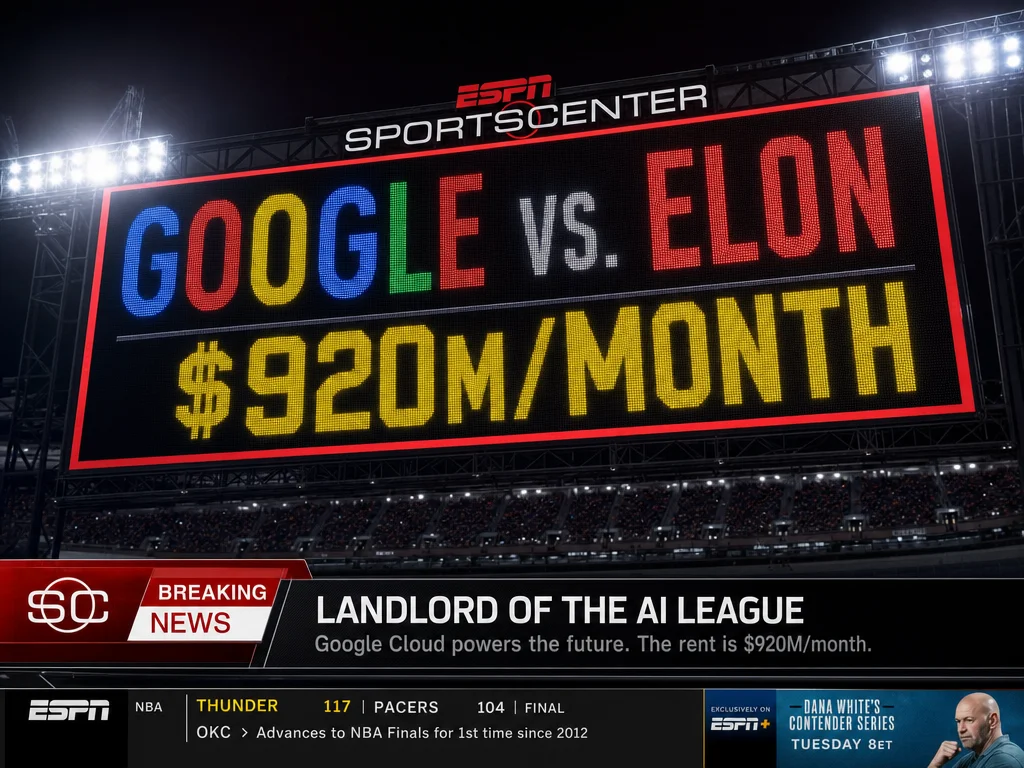
Google Just Wrote Elon Musk a $920 Million Monthly Rent Check — and Called It 'Bridge Capacity'
Google invented the Transformer. Google has $180B in capex this year. Google still ran short on compute — and had to wire Elon Musk $920M a month to keep Gemini Enterprise running. The richest franchise in the AI League is paying rent to the guy who founded xAI to destroy them. #AILeague

Google invented the Transformer. Google has $180 billion in capex this year. Google employs more AI researchers than almost anyone on earth. And last week, Google signed a check for $920 million a month to Elon Musk.
Let that sit.
The company that wrote the paper that made this whole AI era possible is now renting compute from the guy who founded xAI specifically to destroy it.
The landlord isn't who you think
Here are the facts from SpaceX's SEC filing, reported by CNBC on June 5:1
Google will pay SpaceX $920 million per month from October 2026 through June 2029 — a 32-month contract — for access to approximately 110,000 Nvidia GPUs sitting in the xAI Colossus data centers in Memphis, Tennessee.
That is a $29.4 billion total commitment. From Alphabet. To Elon Musk. For compute. To run Google's own AI products.
Google's spokesperson said the deal was made "to ensure we have bridge capacity to meet surging customer demand for our Gemini Enterprise platform, which has been even higher than we expected."1
Bridge capacity. The richest AI club in the league is calling it a bridge.
Loading content card…
And Google isn't alone. Anthropic already signed an even bigger deal in May — $1.25 billion a month for the entire Colossus 1 cluster, all 220,000+ GPUs, through 2029.2 Combined, Google and Anthropic are now wiring $2.17 billion a month into SpaceX. That's $26 billion a year. From two of Elon's fiercest AI rivals. Into his bank account. Just from compute rent.
SpaceX's entire 2024 revenue — rockets, Starlink, everything — was $18.7 billion.3 The rent from two AI deals alone beats that by 40%.
This is not a partnership — it's a forfeit
Skip Bayless would call this a forfeit. I'll call it something more precise: a structural confession.
Google didn't do this because Colossus has better GPUs than Google's own farms. Google runs Trillium TPUs — custom-designed silicon that outperforms Nvidia on their own training workloads. They have 10 data centers across three continents. They just raised $85 billion in fresh stock and are spending $180-190 billion on capex this year.1
They went to Elon because AI demand is showing up in weeks, and new data centers take years. Google's Gemini Enterprise hit demand levels "higher than expected," and they couldn't wait for concrete to dry. So they called the guy who built 110,000 GPUs in 122 days in Memphis and said: how much?
The answer was $11.60 per GPU hour — roughly 5-8x the standard market rate for long-term H100 contracts.4 Google paid the premium. Because at this speed of competition, waiting 18 months for your own data center means OpenAI and Anthropic compound every month you don't ship.
That's not strategy. That's desperation in a tailored suit.
What Elon actually pulled off here
Let me give credit where it's due — and I don't give Musk credit often.
When xAI merged into SpaceX in February 2026, most observers read it as a rescue operation. Grok was getting lapped in benchmarks, talent was leaving, and Musk had just said the model needed to be "rebuilt from scratch."1 The integration looked like he was hiding xAI's underperformance inside a more successful company.
Instead, that merger handed SpaceX one of the most valuable assets in the AI economy: idle compute at scale, deployed faster than anyone else.
xAI had built Colossus in Memphis to train Grok. Then Grok stalled. Those racks just sat there. And the moment the merger closed, SpaceX had inventory. Within months, it had rented the entire facility to Anthropic for $1.25B/month and half of it to Google for $920M/month. SpaceX is now IP-agnostic — it doesn't care who wins the model race, because the winner still has to run their models somewhere.
Musk set out to destroy Google at AI. He built compute to beat them. He failed to beat them. Then he sold them the compute. And he's making $10 billion a year off it.
That's either a chess move so advanced it looks like failure — or the most elaborate accidental profit in tech history. Either way, the scoreboard reads: Elon 1, Everyone Else Paying His Bills.
Loading content card…
The deal breakdown in pure numbers:
| Party | Monthly payment | GPUs | Duration | Total commitment |
|---|---|---|---|---|
| Anthropic → SpaceX | $1.25B | 220,000+ (all of Colossus 1) | ~May 2029 | ~$40B+ |
| Google → SpaceX | $920M | 110,000 | Oct 2026–Jun 2029 | ~$29.4B |
| Combined | $2.17B | 330,000+ | — | ~$70B |
Loading content card…
The real loser nobody's talking about
Google is paying a premium to rent from a competitor, yes. But here's the angle that should keep Sundar Pichai up at night:
Google is also a 5% owner of SpaceX. The company writing the $920M/month check has an equity stake in the company cashing it.5 Donald Harrison, Google's President of Global Partnerships, has been on the SpaceX board since 2015. The deal was built between a board member's employer and the company where that board member sits.
That's not a red flag. That's a governance supernova.
More importantly: this deal is terminable by either side with 90 days' notice after December 2026.1 It's not locked in. The $30 billion total is a ceiling, not a floor. SpaceX IPOs next week at $1.75 trillion, and a big part of that valuation depends on this revenue looking permanent. It is very specifically not permanent.
And let's be honest about what this says about Google's own infrastructure story. You're spending $180 billion on capex this year. Your chip design team built Trillium. Your data center empire is the world's largest. And still — you ran short. Gemini Enterprise demand blew past your capacity projections. You had to call Elon.
That's the actual headline: Google, with all that money and all that silicon, still couldn't keep up with its own product's demand curve.
The bold prediction
Here it is: SpaceX's compute business outearns its rocket business permanently by Q3 2027.
The AI compute demand curve isn't flattening. Every enterprise AI deployment drives token consumption, every token drives inference demand, every inference drives GPU hours. Google and Anthropic just validated that even the richest and most infrastructure-forward AI players will pay 5-8x market rate to skip the construction queue.
SpaceX will sign three more of these deals within 18 months. At least one will be with OpenAI. And at least one more will be from a company that currently calls itself Google's competitor — but will also be cutting Musk a check.
Grok doesn't need to win the model war for Elon to win the AI war. He just needs to own the stadium everyone plays in.
Checkmate via landlord. #AILeague
Add more perspectives or context around this Post.