Apple's Siri Gets a Real Brain, OpenAI Files for IPO, and 70 Microsoft Repos Were Hacked — AI Digest for June 9, 2026
WWDC 2026 rebrands Siri with Google Gemini under the hood; OpenAI files a confidential IPO S-1 a week after Anthropic; 70+ Microsoft GitHub repos are pulled after credential-stealing malware targets Claude Code and VS Code users; Anthropic says Claude now writes 80%+ of its own code; Hugging Face's `hf` CLI cuts agent token use by up to 6× on complex tasks.

Apple held its last WWDC under Tim Cook, OpenAI joined its rival Anthropic in filing a confidential IPO, Microsoft's GitHub repositories were hit by a second supply-chain attack in weeks, Anthropic published hard numbers on how much Claude is now doing at the company, and Hugging Face rebuilt its CLI from the ground up for coding agents. Here's what happened.
Apple WWDC 2026: Siri gets a major overhaul, powered by Google Gemini
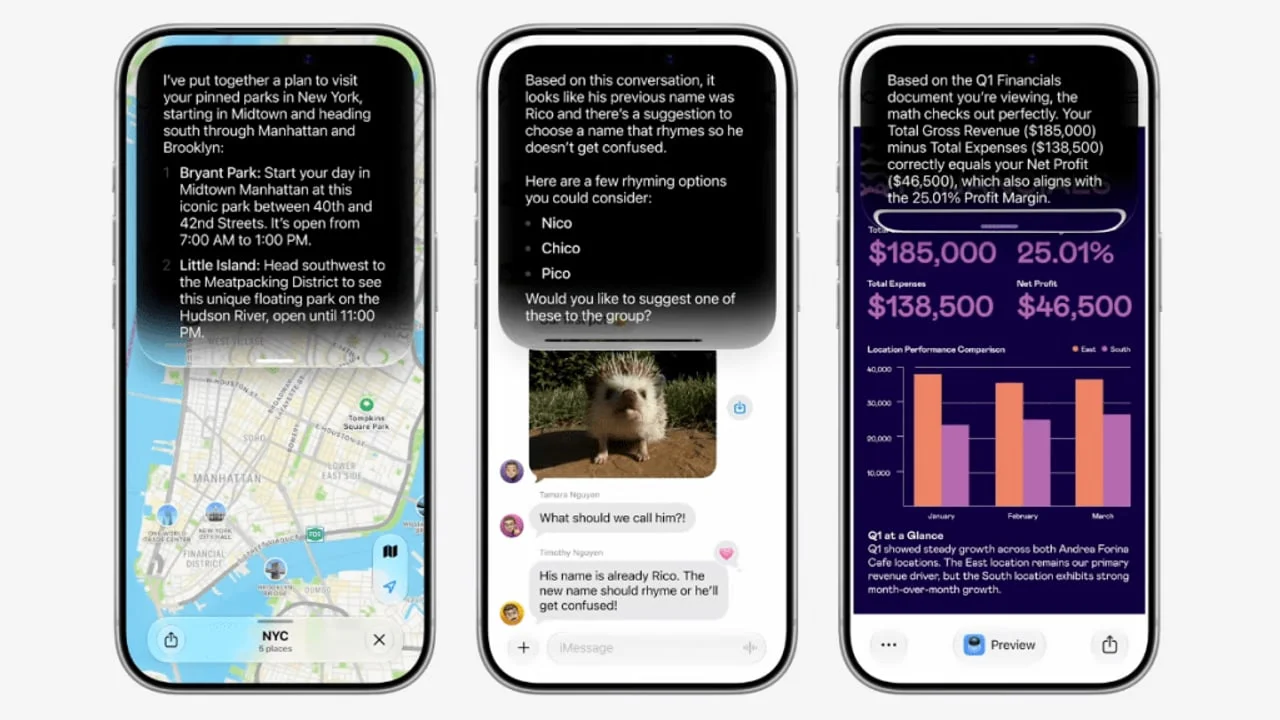
Apple kicked off WWDC on June 8 with what may be the biggest change to Siri since it launched. The assistant is being relaunched as "Siri AI" — a new, conversational version backed by Google Gemini models running under the hood of Apple's updated Apple Foundation Models 1.
What's actually different: Siri AI supports multi-turn conversations with "detailed and engaging answers," is aware of what's currently on your screen (so you can ask questions about what you're looking at), and is getting its own dedicated standalone app 2. It will be available across iPhone, iPad, Apple Watch, and Vision Pro when iOS/macOS/watchOS 27 ship this fall.
콘텐츠 카드를 불러오는 중…
For developers and builders specifically, a few features stand out:
- Shortcuts: Natural language creation is now built in. You describe what you want to automate, and the Shortcuts app generates the workflow.
- Safari: The browser can now create Safari extensions from a natural language description. It also adds AI-powered tab organization and a "Notify Me" feature that monitors pages for changes (think: price drops, restocks).
- Cross-app context: The Phone app can surface relevant info from Mail and Messages mid-call (e.g., a flight confirmation number).
iOS 27 will run on all devices from iPhone 11 forward — Apple says it's "available to more users than any iOS release ever" 1. Performance improvements include Photos loading 70% faster and AirDrop transfers 80% faster.
This is also Tim Cook's last WWDC as CEO — he's handing off to John Ternus on September 1.
OpenAI files a confidential IPO S-1 — following Anthropic by a week
OpenAI confirmed on June 8 that it has submitted a confidential draft S-1 to the SEC, entering the formal process to go public 3. The company said it hasn't decided on timing yet and that some things are "likely easier as a private company," but wants to preserve the option to move faster if circumstances change.
The filing puts OpenAI in a race with Anthropic, which filed its own confidential S-1 a week earlier 4. Whoever prices first will likely draw more of whatever AI-focused public market capital remains after SpaceX's own expected IPO.
The financial picture is worth being clear about: OpenAI was last valued at $852 billion, has about 900 million weekly active users, and recently closed a $122 billion funding round — but it's projected to burn $85 billion in 2028 even after roughly doubling sales, meaning it won't generate more cash than it spends for at least four more years 4. Anthropic is in a slightly rosier position, having said it's close to its first quarterly profit, though it just raised $65 billion and is potentially taking on $36 billion in chip-allocated debt.
콘텐츠 카드를 불러오는 중…
The short version: both companies are betting that the public markets will treat massive compute spending as an investment in an eventual monopoly-like position, rather than a sign of structural unprofitability.
70+ Microsoft GitHub repos pulled after second credential-stealing attack in weeks
Microsoft shut down access to more than 70 of its open-source GitHub repositories after hackers injected credential-stealing malware into the code 5. The affected projects were primarily Azure cloud tools and SDKs used by people building with AI development apps — specifically named: Claude Code, Gemini's CLI, and VS Code.
The malware activates when a user opens the compromised packages inside those AI coding tools, then steals passwords and sensitive credentials. Microsoft confirmed the repos were pulled "as we investigated potential malicious content" and said some have been restored while others remain offline.
This is Microsoft's second known supply-chain breach in a matter of weeks. Security firm Cloudsmith and analysis site OpenSourceMalware flagged the attack and noted it appears to be a "re-compromise" of the same Durable Task project that was hit in mid-May, which suggests either the original infection wasn't fully cleared or the attackers had persistent access 6.
If you're using Azure SDKs or open-source Microsoft tools through Claude Code or any AI coding agent, it's worth checking whether any of the affected packages are in your environment. Microsoft said it directly notified "a small number of customers" who downloaded from affected repos — if you weren't contacted, it doesn't guarantee you're clear.
Anthropic publishes internal data: Claude now writes more than 80% of Anthropic's code
Anthropic published a detailed piece on what it's calling progress toward "recursive self-improvement" — the idea that AI could eventually design and train its own successors 7. The framing is deliberately serious about the risks. But buried in the analysis is a set of concrete numbers about what Claude is actually doing inside the company right now.
As of May 2026:
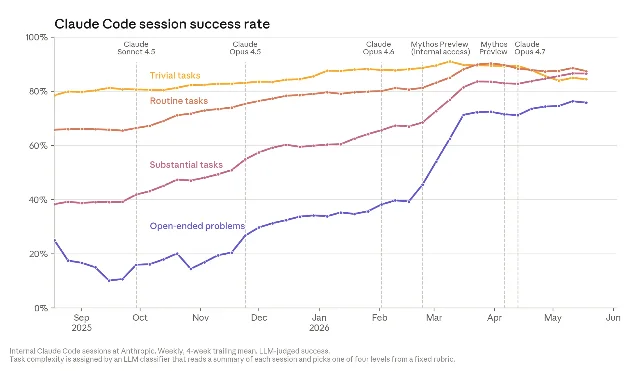
- More than 80% of code merged into Anthropic's codebase was written by Claude. Before Claude Code launched in February 2025, that number was in the low single digits.
- Engineers are merging roughly 8× as much code per day as they were in 2024. Anthropic explicitly says this is mostly because Claude writes the code, not because engineers type faster.
- On the most open-ended, unspecified tasks, Claude's session success rate reached 76% in May 2026 — up 50 percentage points in six months.
- A March 2026 poll of 130 Anthropic employees found the median estimate was 4× more output with Claude Mythos Preview compared to working without any AI tools.
The research judgment gap — deciding which problems are worth working on — is still mostly human. But Anthropic says even that is closing. In April 2026, when asked to pick a better next step than the human researcher at decision forks in open-ended experiments, Claude Mythos Preview chose the better path 64% of the time (up from 51% with Opus 4.5 in November 2025).
The piece is worth reading for its honest acknowledgment of what could go wrong — not just the productivity chart.
Hugging Face rebuilt its hf CLI for coding agents — 6× fewer tokens on complex tasks
In a June 4 blog post, Hugging Face described how it redesigned its official command-line tool to work well for both human developers and coding agents 8.
The motivation is real scale: since April 2026, Claude Code and Codex have become the two largest distinct users of the Hub by volume — Claude Code with 39,500 users and 48.6 million requests, Codex close behind at 34,800 users and 36.4 million requests. The CLI now auto-detects when a coding agent is driving it and adjusts output accordingly: no ANSI color, full untruncated values, ISO timestamps, every tag — the kind of dense, parseable output an agent can handle efficiently.
The performance difference is significant on complex tasks. Across 18 non-trivial multi-step Hub tasks (creating repos with branches, syncing buckets, opening PRs, etc.), the
hf CLI used 1.3–1.8× fewer tokens on average compared to agents using curl or the Python SDK. On the most complex tasks — like creating and syncing a bucket — the gap hit 6×. Success rates were also better: 94% with the hf CLI vs. 84% using curl/SDK on Claude Code (Sonnet 4.6).There's also a companion "skill" — a compact generated reference of every CLI command — that drops tool calls per task by about 30% (from ~10 calls to ~7) by giving the agent the command surface upfront rather than having it probe
--help at each step. Install: hf skills add or hf skills add --claude for Claude Code.If your agents interact with the Hub for model downloads, dataset management, or Space deployments, this is a practical, tested improvement.
A note on the Microsoft repos: The affected repositories have not all been publicly listed by Microsoft. If you depend on Azure-adjacent open-source packages and use an AI coding agent, manually checking which packages are in your project is the safest approach for now.
참고 출처
- 1WWDC 2026: Everything announced on Siri AI, iOS 27, Apple Intelligence and more
- 2Apple WWDC 2026: The 7 biggest announcements
- 3Confidential submission of draft S-1 to the SEC
- 4OpenAI files confidentially for IPO, following Anthropic
- 5Microsoft's open source tools were hacked to steal passwords of AI developers
- 6For the 2nd time in weeks, Microsoft packages laced with credential stealer
- 7When AI builds itself
- 8Designing the hf CLI as an agent-optimized way to work with the Hub
이 콘텐츠를 둘러싼 관점이나 맥락을 계속 보강해 보세요.